Book Blurb:
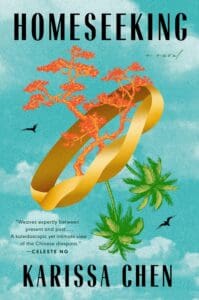
Haiwen is buying bananas at a 99 Ranch Market in Los Angeles when he looks up and sees Suchi, his Suchi, for the first time in sixty years. To recently widowed Haiwen it feels like a second chance, but Suchi has only survived by refusing to look back.
Suchi was seven when she first met Haiwen in their Shanghai neighborhood, drawn by the sound of his violin. Their childhood friendship blossomed into soul-deep love, but when Haiwen secretly enlisted in the Nationalist army in 1947 to save his brother from the draft, she was left with just his violin and a note: Forgive me. Homeseeking follows the separated lovers through six decades of tumultuous Chinese history.
My Review: 4.25 stars
Homeseeking by Karissa Chen was a quiet and absorbing story about a young couple separated by war and the unlikely way they find each other sixty years later.
This book covers many decades of Chinese history and the many atrocities the people had to suffer through: famine, communist takeover, the Chinese Civil War and of course, the Second Sino Japanese War between the Republic of China and the Empire of Japan. I loved the history in this book and learned/relearned a meaningful amount.
The way Chen tells this story was quite good. Suchi, the FMC, tells her story from past to present, while Haiwen (MMC) tells his story from present to the past. I appreciated the dedication and timeline juggling that must have taken.
The book also offers a grand message: How a single, quickly made act can ultimately affect many lives. We never know how a decision will play out or how many people it will touch – good or bad. This theme, as well as grief, love, and family connection are woven through the book. As much as I was invested in the story, it was the past storyline that I enjoyed the most. The present didn’t feel nearly as compelling, yet it didn’t hinder my overall reading experience. If you’re a fan of Pachinko, you’ll love this one too. I’m looking forward to what’s next from this author.
Quotes I liked:
I’m afraid of a lifetime of remembering the things I want to forget.”
“That’s why I read all kinds of papers, to see what each one says. So I can compare. I consider not just what they’re saying but how they’re saying it. And I measure what they’re saying against what I know of the world, what I’ve seen and experienced with my own eyes, what I’ve learned about human nature and history.”